Coal: Part II
Global Dominance and Modern Challenges
From J.P. Morgan's steel empire and the electrification of cities to the World Wars, labor struggles, and coal's role in shaping modern China and India—the complete story of coal's global dominance and its impact on our climate future.
Introduction & Recap
From Ancient Swamps to Steam
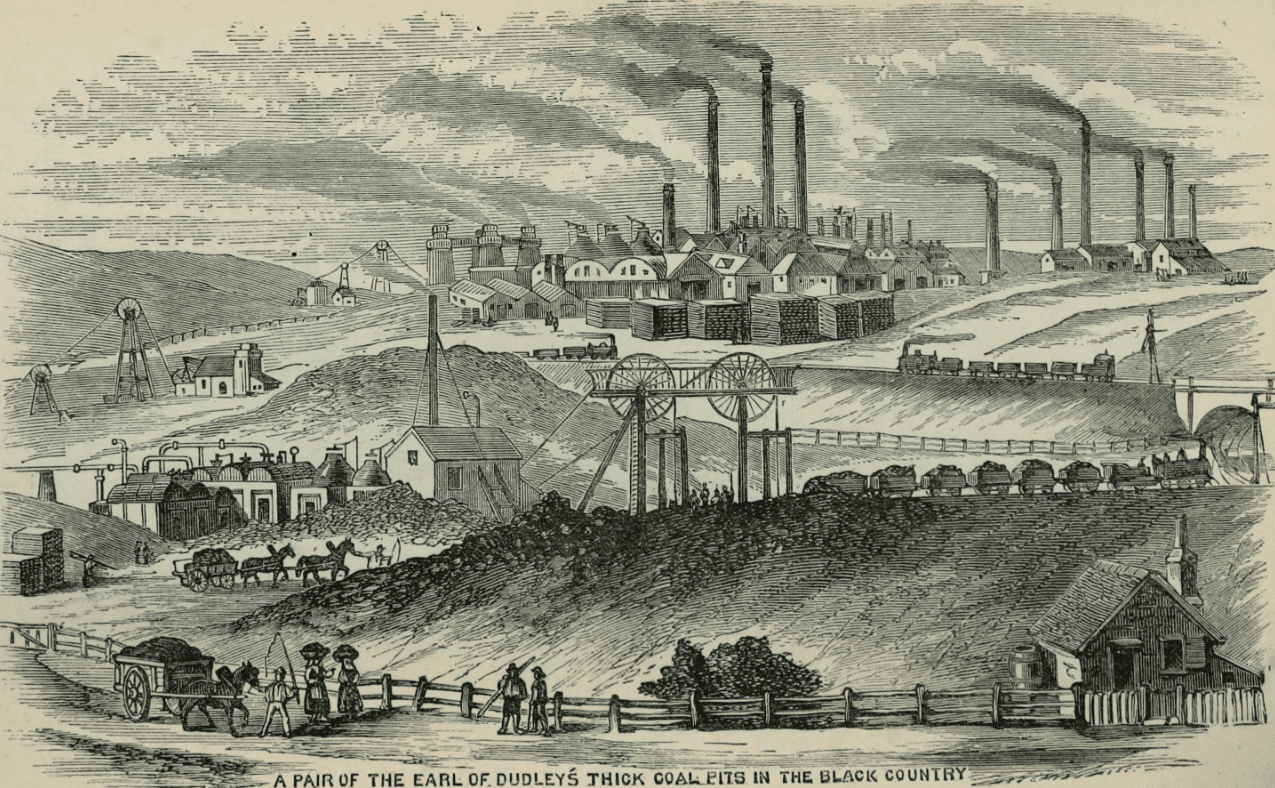
If you missed Part One, we began in the Carboniferous period, tracking how ancient forests evolved into the coal that eventually replaced wood in Britain. The true inflection point arrived in the 1700s, when the steam engine allowed us to turn this black rock into mechanical power.
This power moved trains, pumped water, and drove the explosive growth of cities like Manchester and Birmingham. It eventually spread to the United States, propelling the North to victory in the Civil War and fueling the rise of railroad monopolies and labor struggles in the late 1800s.
The Other 97 Percent
Now we enter Act Two, where coal becomes the beating heart of America's rise and the spark behind the birth of electricity. It evolves into the bloodline of global warfare and the fuel that eventually powered the rise of modern industrial giants like China and India.
To put this evolution in perspective, everything covered in Part One represents less than 10%—and by some estimates less than 3%—of the total coal humanity has used. Today, we are here to tell the story of the other 97%.
Before we jump into this era of King Coal, please take a moment to subscribe and rate the show to help others find us. We are now entering the late 1800s, a period defined by the massive scale-up of American infrastructure and the quiet transition of coal from a visible fuel to an invisible force.
Arteries of Capital: Morgan & The Railroads (1870-1900)
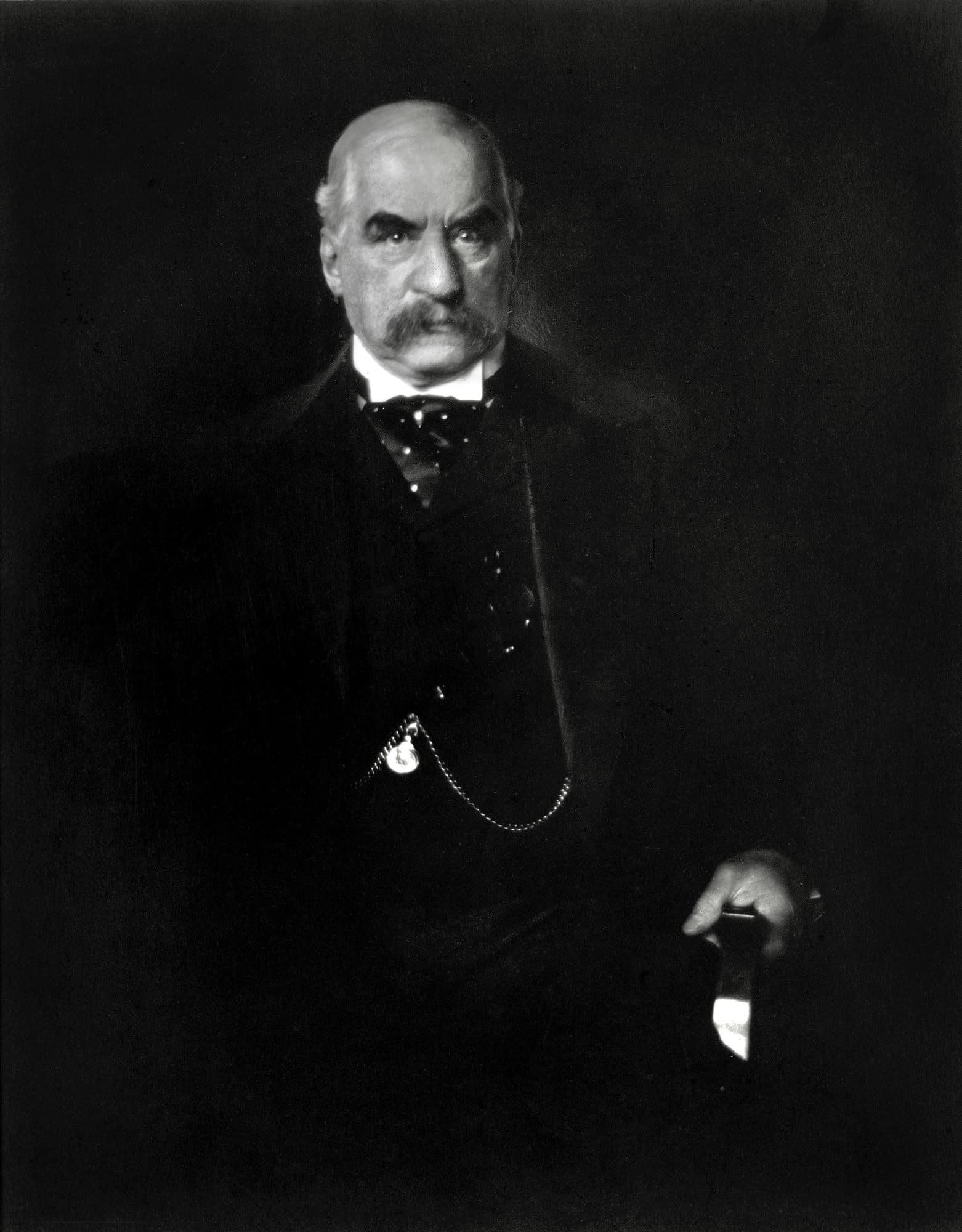
J.P. Morgan, circa 1900s. His financial empire controlled the flow of coal across America.
Order From Chaos
J.P. Morgan’s financial empire was not merely built on banking, but on a strategic vision of infrastructure. He understood that controlling transportation was the key to dominating entire industries. Because coal was the essential fuel for everything from locomotives to steel mills, controlling the railroads meant Morgan became the ultimate middleman for the nation's energy needs.
In the mid-1800s, the American railroad industry was a chaotic mess of hundreds of small, competing lines. Many were deeply in debt and poorly run, operating on different track gauges that made regional systems incompatible. Morgan believed that by rationalizing this system, he could turn these erratic lines into predictable revenue machines.
Leveraging capital from European investors and his father’s connections in London, Morgan began his consolidation efforts. His first major play came in 1879, when he stepped in to save the Albany and Susquehanna Railroad. The line was caught in a bitter battle between Jay Gould and the Vanderbilt family, allowing Morgan to enter as a mediator.
This established a lucrative pattern for Morgan: finding a moment of crisis or conflict, entering as a neutral party, and emerging as the owner. By securing deals for powerful families like the Vanderbilts, he ensured that his railroads had the capital reserves to survive financial panics that bankrupted his competition.
The Vertical Empire
Morgan applied this same strategy to the Reading Railroad, which had aggressively consolidated coal mines but overextended itself into financial instability. Seeing an opportunity to control both the transport and the fuel source, Morgan swooped in to restructure the company. He realized that if you own the transportation network, you effectively dictate the pricing for everyone else.
By merging smaller coal-hauling lines and placing allies on boards, Morgan sat atop a vertical empire of coal extraction, pricing, and delivery. This stabilization helped explode the American rail network from 53,000 miles in 1870 to 250,000 miles by 1915. But as the rail network expanded, it demanded a material stronger and more durable than iron.
The railroads were the largest consumers of steel, which required "coke"—processed coal—to smelt. Enter Andrew Carnegie, a Scottish immigrant who began his career as a telegraph operator. Carnegie recognized early on that iron rails were too brittle for heavy loads and bet his future on the promise of steel.
The breakthrough came from Henry Bessemer, who developed a pear-shaped converter that could blast air through molten iron. The oxygen in the air reacted with impurities like silicon and carbon, burning them off in a violent reaction. What previously took a full day to produce now took only ten to twenty minutes.
While others dismissed Bessemer's claims, Carnegie witnessed the process firsthand and went all-in. He built the Edgar Thomson Steel Works during the economic crash of 1873, a move competitors called insane. Yet, by vertically integrating his supply chains—owning the coal mines, the coke, and the transport—he cut costs in half and dominated the market.
The Billion Dollar Napkin
By 1900, Morgan and Carnegie were the titans of American industry, but competition was driving down prices. Morgan proposed a buyout to stabilize the market, sending Charles Schwab to pitch the idea. Carnegie scribbled a figure on a napkin—$480 million—and slid it across the table.
Morgan accepted immediately, reportedly telling Carnegie, "Congratulations, you are now the richest man in the world." In 1901, Morgan merged these assets to form U.S. Steel, the first corporation valued at over a billion dollars. He now controlled the coal, the iron, the steel, and the railroads that moved them all.
Morgan’s concentration of capital was so immense that he effectively became the nation's central bank. During the panics of 1895 and 1907, he single-handedly injected millions to save the U.S. gold standard and the New York Stock Exchange. He was the "lender of last resort," a realization that eventually prompted the government to create the Federal Reserve.
Yet, as steel skeletons rose in Manhattan, a subtler revolution was brewing that would redefine energy usage. For decades, electricity had been a scientific curiosity, powered by primitive chemical batteries. But the discovery of electromagnetism by Michael Faraday—that moving a magnet near a wire creates current—was about to bridge the gap between coal and pure energy.
When Faraday first demonstrated this principle, he was asked what use it could possibly have. He famously replied, "What is the use of a newborn baby?" That baby was about to grow up, turning the burning of coal into the invisible force that would power the 20th century.
The Age of Steel: Carnegie's Empire (1870-1900)
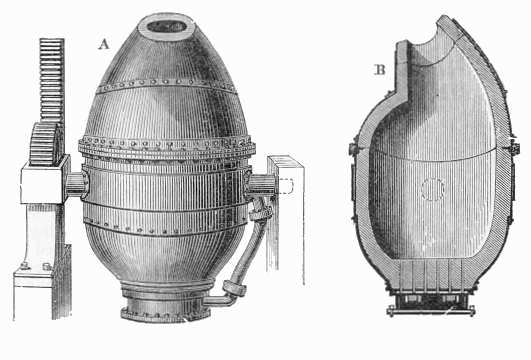
The Bessemer converter in action, transforming coal-fueled iron into the steel that built America.
From Dynamos to Gaslights
While J.P. Morgan was consolidating the nation's railways, a quiet revolution was beginning in the world of physics that would eventually supersede steam. It began with the visualization of a magnet and a spinning coil of wire, a relationship that generated an alternating current (AC). By the early 1870s, engineers had developed the coal-powered dynamo, finally turning the heat of coal into motion, and that motion into direct current (DC) power.
The first application of this new power was lighting, specifically the arc lamp, which worked by sparking high voltage between carbon electrodes. These lamps were intensely bright and used primarily for public spaces in cities like Paris. However, the light was so harsh and pulsing that critics described it as "unearthly" and fit only for "murders and public crime," driving many to prefer the warm, domestic radiance of gas.
The incumbent champion of illumination was coal gas, a byproduct of heating coal into coke. This "town gas" was piped through urban centers to light homes and streets, creating a booming industry for suppliers. Major infrastructure projects, like the gasworks in Seattle and San Francisco, required massive shipments of coal to be gasified and piped out to growing neighborhoods.
Despite its prevalence, coal gas was messy, requiring manual lighting and creating fumes that made it a hassle for daily living. The public was primed for a cleaner alternative, but the harsh arc lamps of the time were unsuitable for interior spaces. There was a clear market pull for a new form of light, but the technology had yet to deliver a product that customers actually wanted in their homes.
The Banker and the Bulb
Enter Thomas Edison and his Menlo Park laboratory, where he applied brute force persistence to the problem of incandescent lighting. By 1879, after countless experiments, his team succeeded with a carbonized filament that offered a soft, steady glow. Financing this venture was none other than J.P. Morgan, who, despite his reputation as a conservative traditionalist, had a keen eye for the "new temper of the times" and a deep admiration for Edison's boldness.
Morgan decided to personally showcase this technology by making his Madison Avenue brownstone the first private residence in New York lit solely by electricity. This was no simple utility hookup; it required installing a coal-powered dynamo in the basement managed by an engineer. The system was so manual that if the engineer went home at 11:00 PM while Morgan was still entertaining, the house would simply plunge into darkness.
Edison’s vision extended far beyond individual home generators; he wanted to embed electricity into the city's infrastructure, replacing the "rat's nest" of overhead wires with underground tubes. In 1882, he launched the Pearl Street Station, the world's first commercial power plant, serving 85 customers in lower Manhattan. The glowing New York Times building became a beacon of this new era, prompting reporters to describe the light as "brighter, purer, and more perfect" than anything before.
The gas companies saw their stock prices plummet, leading skeptics in the British Parliament to dismiss Edison's claims of electric heating and cooking as "absurd." Edison, undeterred, aimed for a vertical monopoly where he sold the current, the bulbs, and the infrastructure. Morgan, however, saw the business differently, preferring to control the machinery and corporate structure rather than managing the complex utility of power generation itself.
The Machinery of Scale
As the market for electricity heated up, a fierce "war of the currents" broke out between Edison's DC system and the AC system favored by Westinghouse and Tesla. Morgan, ever the stabilizer, ended the conflict by buying the competition. In 1892, he merged Edison General Electric with Thomson-Houston to form General Electric (GE), creating a corporate giant that would dominate the industry for over a century.
The next great leap in efficiency came not from finance, but from the invention of the steam turbine by Charles Parsons. By replacing reciprocating pistons with a spinning fan driven by high-pressure steam, the turbine radically simplified the conversion of coal into motion. This innovation tripled the efficiency of power generation, marking a shift as fundamental as Watt’s original steam engine.
This efficiency triggered Jevons paradox: rather than using less coal, the lower cost of energy led to a massive increase in consumption. Edison’s team, recognizing the turbine's potential, partnered with GE to build the massive Fisk Street station in Chicago. These new turbines looked like jet engines pointed at the sky, capable of generating twice as much power as any previous steam engine.
The implementation of these massive plants was spearheaded by Samuel Insull, who pioneered the modern concept of the electric utility. Insull understood that the high cost of building power plants meant they needed to run at full capacity to be profitable. He focused on scaling up, lowering prices to get more customers "hooked," and establishing regulated monopolies, effectively creating the electrical grid structure we rely on today.
The Physics of Light: Electricity's Dawn (1800-1890)
Richard Feynman's brilliant explanation of electromagnetic induction and Faraday's law—the physics that made the electric generator possible and turned coal into electricity.
Rewiring the Nation
While the theoretical understanding of electromagnetism began in the laboratories of the 19th century, its transformation into a global utility was a breathless race in the early 20th. In 1905, less than 10% of American homes were wired for electricity; by the late 1920s, that number had surged to 75%. This explosion was driven by figures like Samuel Insull, who pushed for the standardization of voltages and the creation of an expansive, centralized grid—a monopoly model that prioritized efficiency but locked the nation into a system of massive, centralized power generation.
The impact on daily life was total. Electricity ceased to be a luxury for the likes of J.P. Morgan and became the heartbeat of the modern city, allowing factories to run 24 hours a day and streetcars to expand urban centers into suburbs. Inside the home, the electric washing machine and refrigerator revolutionized domestic labor, while the radio connected millions to the world in real time. Yet, behind this clean, silent power lay a mountain of soot; by the 1920s, America burned so much coal for electricity that a hypothetical train of coal cars would stretch from New York to San Francisco and back every single day.
The Fuel of Empires
This electrification was not unique to America; Europe was undergoing a parallel transformation, turning coal into the lifeblood of geopolitical dominance. As the Great Powers of Europe—Britain, Germany, and rising Russia—drifted toward conflict in 1914, their industrial might was measured in carbon. World War I became the first true industrial war, where the movement of troops, the production of steel for artillery, and the speed of battleships all depended entirely on the black rock.
Britain held a distinct advantage with its supply of high-quality Welsh anthracite—clean-burning and energy-dense—and its global network of coaling stations. From Gibraltar to Vancouver, the Royal Navy could refuel anywhere, while German ships were left vulnerable, forced to carry massive stockpiles of fuel that limited their speed and range. The war at sea became a war of logistics, where cutting off a rival's coal supply was as effective as sinking their fleet.
The naval arms race also spurred rapid technological innovation, most notably the steam turbine invented by Charles Parsons. In a dramatic publicity stunt during Queen Victoria’s Diamond Jubilee, Parsons’ ship, the Turbina, blazed past the Royal Navy’s fastest vessels at 39 miles per hour, forcing the Admiralty to take notice. This led to the creation of the HMS Dreadnought in 1906, a turbine-powered battleship that rendered all previous warships obsolete, burning a thousand tons of coal a day to project British power across the oceans.
Total War and Collapse
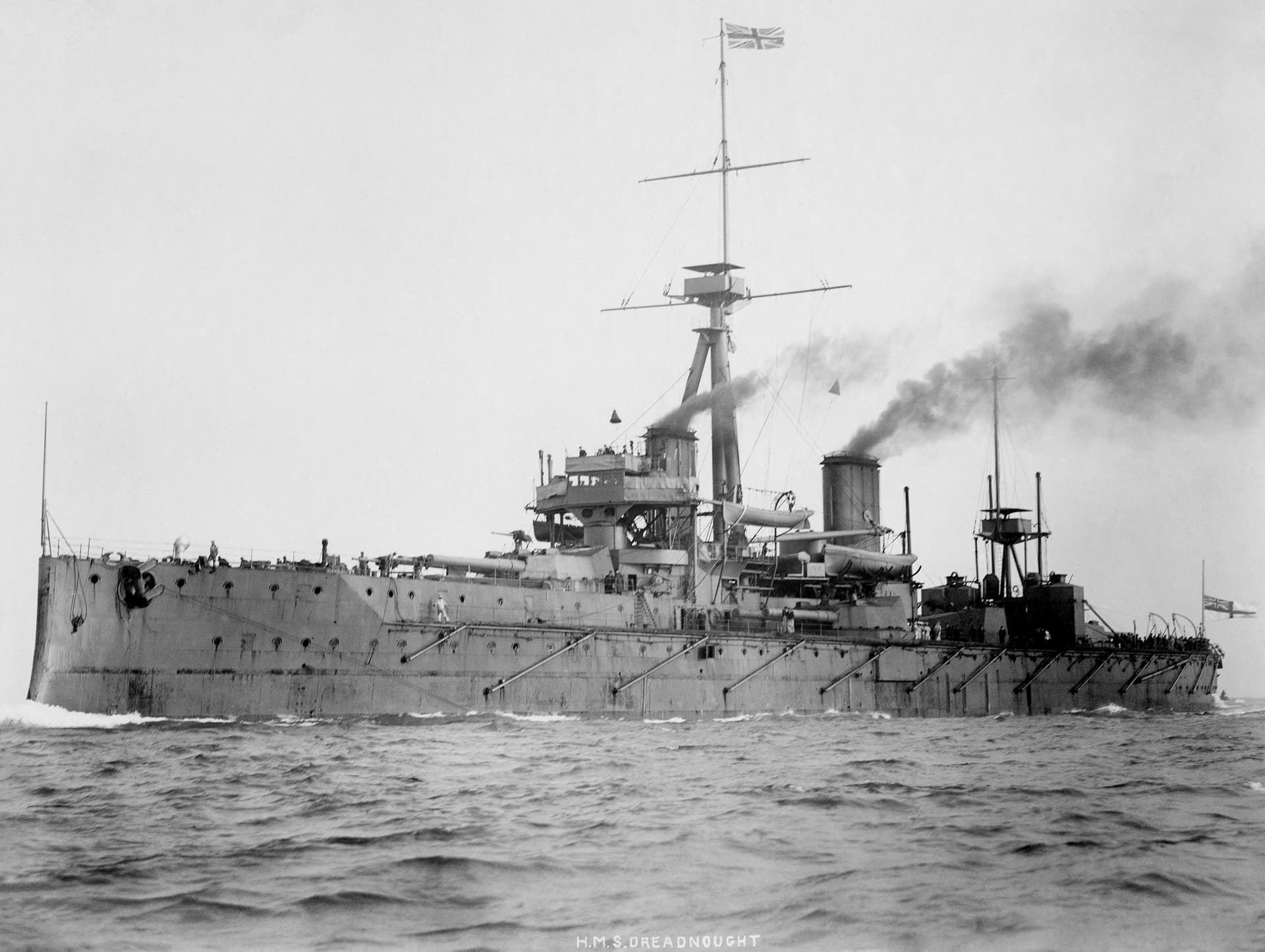
HMS Dreadnought, 1906. The coal-powered turbine battleship that revolutionized naval dominance.
Germany, lacking Britain's naval reach, turned its coal expertise inward, using it to drive a sophisticated chemical industry. Companies like BASF converted coal byproducts into explosives and synthetic fertilizers via the Haber-Bosch process, allowing Germany to sustain its war effort despite naval blockades. However, the sheer energy demands of the conflict eventually caught up with them.
By the "Turnip Winter" of 1916-1917, Germany faced a catastrophic energy crisis. Coal shortages crippled the railways, delayed ammunition shipments, and left civilians freezing in their homes. The collapse of the German war machine in 1918 was as much a failure of fuel supply as it was a military defeat. The subsequent Treaty of Versailles recognized this strategic reality, stripping Germany of key coal-producing regions to hamstring its future military potential.
The Miner's Rebellion
Peace brought no relief to the men who dug the coal. In both Britain and the United States, miners faced falling wages and brutal working conditions as the industry struggled against new competitors like oil. In West Virginia, tensions exploded into open warfare at the Battle of Blair Mountain in 1921, where coal companies hired private armies and even used aircraft to drop homemade bombs on striking miners. It remains the largest labor uprising in U.S. history since the Civil War, quelled only by the intervention of federal troops.
The Great Depression further devastated the coal communities, but the coming of the New Deal and World War II would dramatically reshape the landscape of labor and energy. Under the fiery leadership of John L. Lewis, the United Mine Workers regained their strength, becoming a political force capable of challenging even the President. As the world moved toward another global conflict, the stage was set for a new era where the control of energy would once again define the fate of nations.
The Machine in the Garden: Building the Grid (1890-1930)
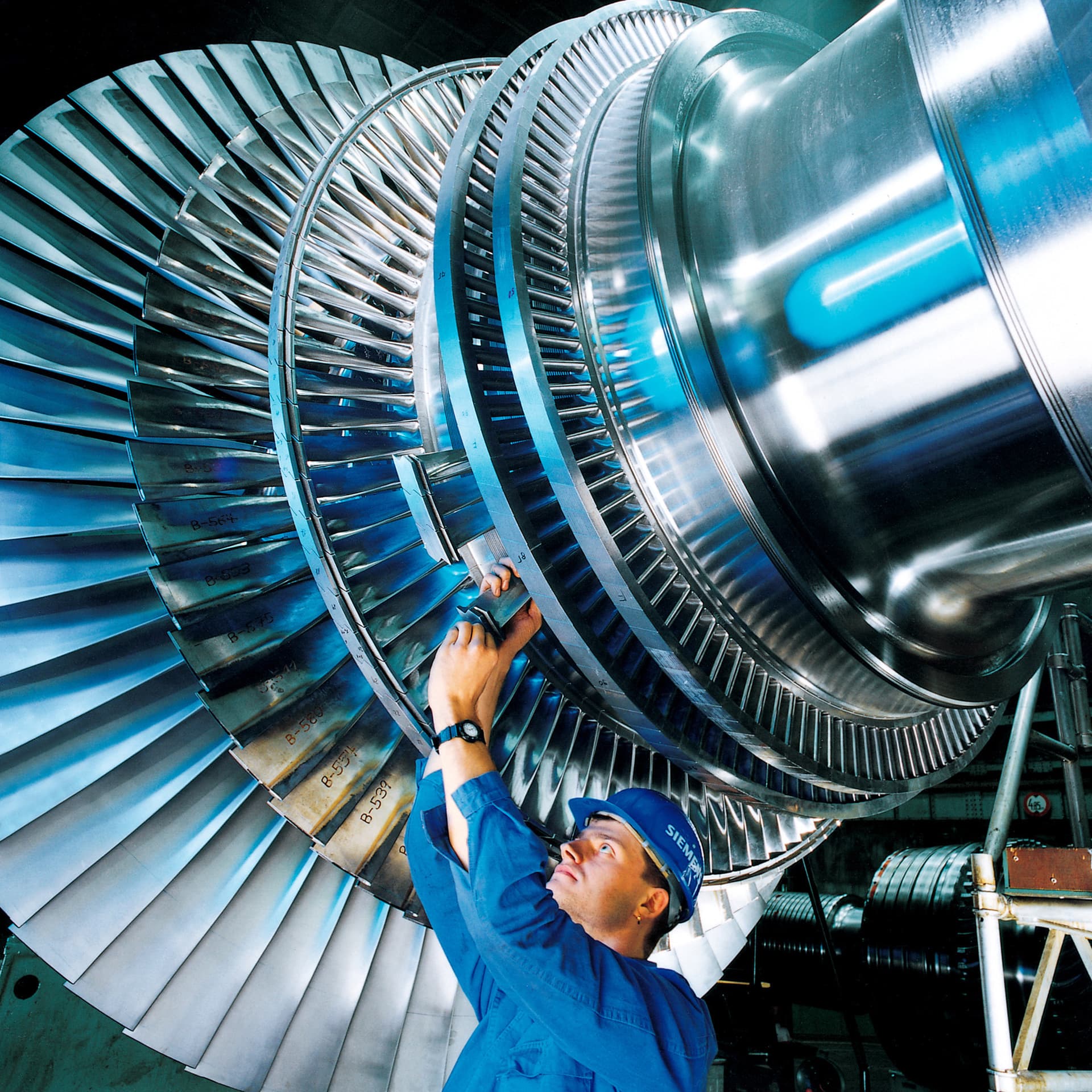
Modern coal power plant turbine — coal's invisible form powering the 20th century.
The Changing Guard of Energy
By the mid-20th century, the public face of coal had transformed from heroic to hostile. John L. Lewis, once the titan of labor, was depicted on magazine covers with a face like an erupting volcano, becoming one of the nation's most hated figures by 1949.
While the unions fought for power, the energy market quietly shifted beneath their feet. The oil industry watched the coal strikes with glee, noting that every disruption in the mines pushed more of the American market toward petroleum, causing the dominance of the coal unions to slowly crumble.
The distinct natures of the two World Wars illustrate this transition. If coal was the "oxygen" of World War I—fueling the static trench warfare and heavy naval battles—it became a backstage player by World War II. The second war was mechanized, fought in the skies and with fast-moving tanks, all powered by the "sexy" new fuel: oil.
Germany, lacking natural oil reserves, was forced to rely on its chemical industry to sustain its war machine. Through a process of coal liquefaction, they converted their abundant coal supplies into synthetic oil, a desperate but critical strategy to keep their tanks rolling when supply lines were cut.
In Britain, the desperation for energy led to the chaotic "Bevan's Boys" program, where conscripts were randomly drafted not for the front lines, but for the coal mines. This deeply unpopular move was followed by the nationalization of the industry in 1946, where the government bought out the mines for £81 million, hoping to modernize a sector that was largely in decline.
Inside the Megamachine
Despite the rise of oil in transportation, coal found its enduring fortress in the electric grid. To understand the scale of this power, one must look inside the modern coal plant, where conveyor belts move 4,000 tons of fuel per hour—the weight equivalent of 4,000 small cars moving continuously into the maw of the machine.
Before burning, massive steel rollers pulverize the coal into a dust as fine as talcum powder. This dust is blown into a furnace to create a suspended fireball over 200 feet high, generating temperatures of 2,500 degrees Fahrenheit—hotter than lava—which turns the surrounding water pipes into superheated steam.
This steam is the muscle behind the grid. It strikes the blades of a steam turbine, a machine as long as a school bus and weighing hundreds of tons. Under immense pressure, this massive metal beast spins at 3,000 revolutions per minute, achieving the mechanical precision of a Swiss watch at the scale of a skyscraper.
It is here that thermal energy becomes electricity, as the spinning turbine drives a generator, moving magnets inside copper coils to send 275,000 volts out onto the grid. The process concludes at the iconic cooling towers, which release plumes of steam while consuming enough water to fill an Olympic swimming pool every 90 minutes.
A Revolution in the East
While the West built its grid, a different kind of power was building in China. Following the humiliations of the Opium Wars and foreign control over mines like Kaiping, a rising tide of nationalism began to view industrialization not as progress, but as Western exploitation.
In 1921, a young Mao Zedong traveled to Jiangxi Province, home to a large coal mine and railroad. Utilizing a connection with a relative there, Mao began to organize the miners, winning their trust by offering something radical: free education for their children, a privilege previously reserved for managers.
Mao eventually instructed the workers to strike, demanding higher wages and fundamental dignity. Unlike the violent and often fruitless labor conflicts in the UK and US during this era, the strike was an orderly, resounding success, securing all the workers' demands.
This victory became a foundational myth for the Chinese Communist Party. Decades later, propaganda posters would depict Mao striding over mountains in scholar's robes, organizing the miners who would help fuel the rise of a new global superpower.
The Great Acceleration: China and the Modern Coal Wars
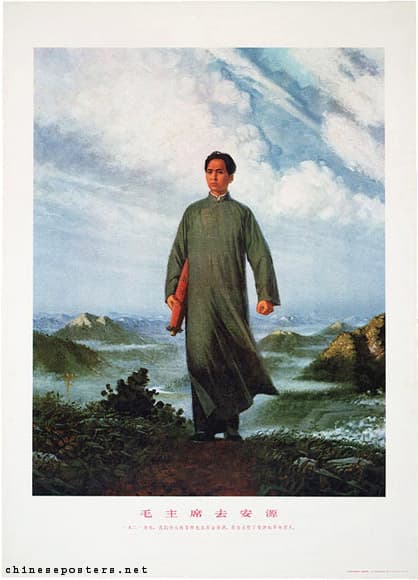
Communist propaganda depicting Mao organizing coal miners, establishing the ideological link between labor and power.
The Dragon Wakes
While the West wrestled with labor and grids, a new industrial giant was stirring in the East. In Northeast China, a region then known as Manchuria, the Japanese had already established mines and railroads to fuel their own industrial ambitions, laying the groundwork for what would become one of the most industrialized parts of China.
Following the communist takeover in 1949, Mao Zedong looked to these resources with a singular, ambitious goal: to outdo the Industrial Revolution itself. In the summer of 1958, he launched the "Great Leap Forward," an unprecedented experiment in human mobilization designed to surpass Great Britain’s production levels by tapping into China's vast population.
Rather than centralizing industry, the party demanded that farmers dig for coal and build steel furnaces directly in their backyards. The scale was astronomical, with nearly 100 million people tending to millions of primitive brick furnaces, producing what turned out to be useless "cattle droppings" steel.
From Famine to Fuel
The experiment ended in tragedy, pulling labor away from agriculture and contributing to a famine that claimed tens of millions of lives. Yet, from this devastation, China pivoted back to geographic centralization, steadily marching toward a successful extraction model that would eventually overshoot its own ambitious five-year plans.
Under Deng Xiaoping’s reforms in the 1980s, the nation embraced Western technology and economic markets, unlocking a massive boom in mining. By the early 2000s, China had achieved escape velocity, consuming 30% of the world's coal—more than the United States and the next largest consumer combined.
The American Resurgence
Meanwhile, the United States was facing its own reckoning; by the 1970s, oil and gas had largely displaced coal, which many viewed as a dying fuel of the past. That complacency shattered in October 1973, when OPEC imposed an oil embargo that quadrupled prices overnight and left Americans waiting in gas lines for hours.
Almost immediately, energy became a matter of national security rather than just economics. President Nixon announced Project Independence, placing coal back at the center of American strategy as a reliable, domestic alternative to foreign oil.
The resurgence was cemented in 1979 by the partial meltdown at Three Mile Island, which halted the growth of the nuclear industry. With nuclear sidelined and oil volatile, utilities had no choice but to lean heavily into coal, driving production up by 40% in just seven years.
Moving Mountains
This new demand shifted the center of gravity to the American West, specifically Wyoming’s Powder River Basin, where coal seams were immense and accessible. The industry moved away from deep underground shafts to surface mining, using explosives on such a massive scale that Russian scientists occasionally mistook the tremors for nuclear tests.
This was mountaintop removal and strip mining, a highly mechanized process where workers drove house-sized excavators in clean clothes rather than crawling through dust. Efficiency soared, with a dozen workers capable of dismantling a mountain, though the environmental cost to the landscape was total devastation.
Debris was pushed into valleys, burying streams, while industry lobbyists successfully reclassified this waste as "acceptable fill." Fueled by these ruthless efficiencies, coal remained the king of the grid well into the 2000s, powering half of US electricity generation.
The Coal Rush and the Resistance
As the 21st century approached, the industry faced a new threat: the growing consensus on climate change. Major players like Peabody Energy fought back with aggressive PR campaigns, even arguing that carbon dioxide was "plant food" and a gift from God intended to be burned.
Anticipating future regulations, the industry launched a "Coal Rush" around 2005, aiming to build over 150 new power plants before rules could tighten. It was a massive bet on coal's continued dominance, involving hundreds of billions of dollars in new infrastructure.
However, they met unexpected resistance from the "Beyond Coal" movement, a coalition of local activists and national organizations like the Sierra Club. By fighting plant by plant using the Clean Air Act and local zoning laws, this grassroots uprising successfully blocked or cancelled over 200 proposed plants, effectively halting the coal rush in its tracks.
The Great Displacement & The Eastern Rise (2000-2015)
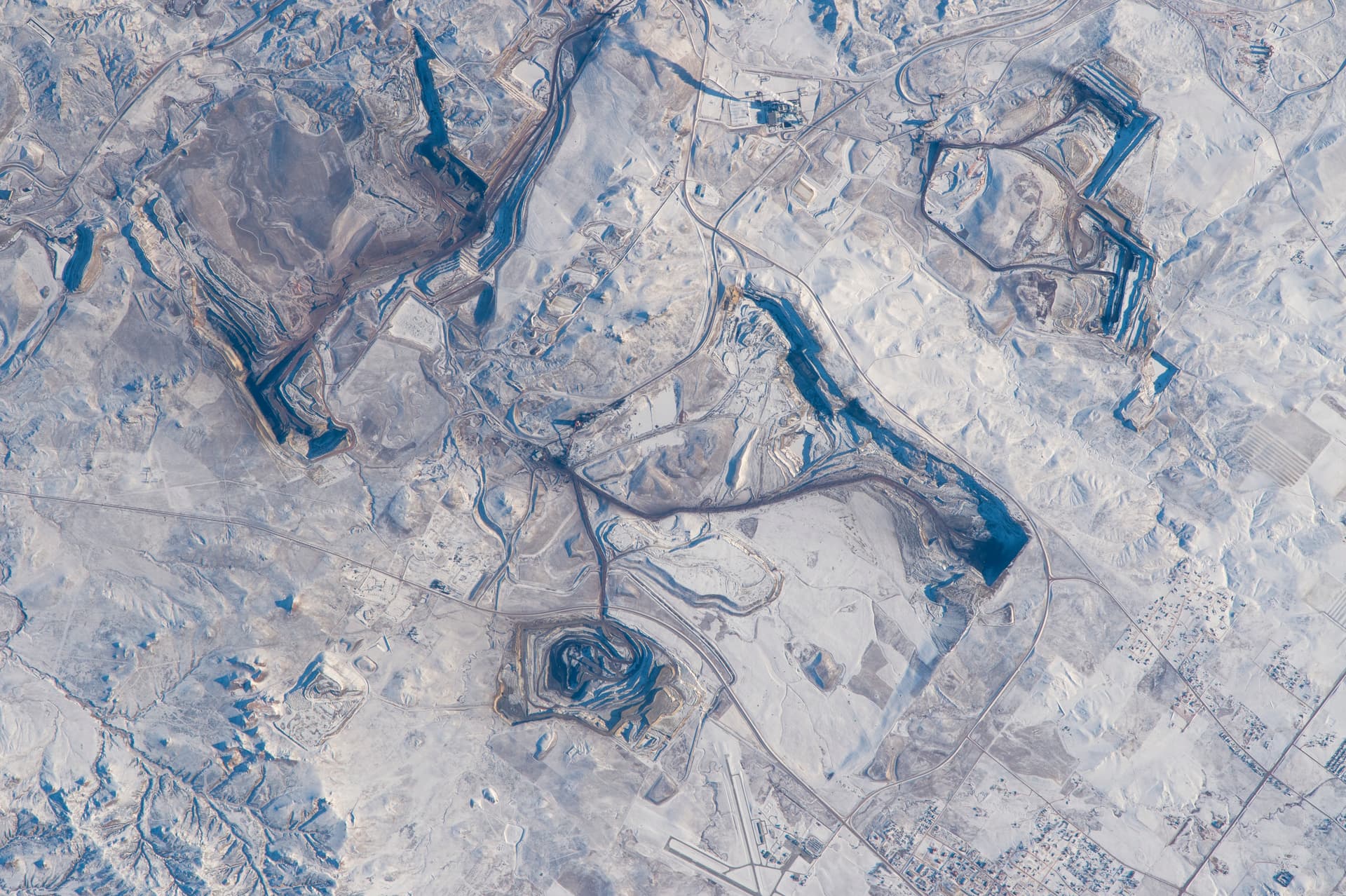
Powder River Basin, Wyoming — mountaintop removal mining reshapes landscapes on an unprecedented scale.
Regulation vs. The Market
While the early 20th century laid the foundations of industrial coal power, the early 21st century brought a reckoning. By 2008, the scientific consensus on global warming was unequivocal, yet political attempts to curb coal, such as the Waxman-Markey Bill, crumbled under the weight of the Great Financial Crisis. In that moment of economic fragility, short-term stabilization took precedence over long-term climate action, and regulation failed to deliver the knockout blow to the coal industry.
But where regulation hesitated, the market delivered a vicious combination of punches. The "uppercut" came from the controversial rise of hydraulic fracturing, or fracking. In 2005, the Energy Policy Act introduced the "Halliburton Loophole," exempting fracking from key provisions of the Safe Drinking Water Act. This deregulation reclassified industrial fluid injection not as waste, but as fill, opening the floodgates for a new era of extraction.
Technological breakthroughs in 2008 allowed drillers to crack deep shale rock formations, releasing trapped natural gas that had previously been economically unviable. The result was a boomtown effect: shale gas went from 5% of U.S. production to over 50% by 2015. Consequently, natural gas prices plummeted by over 55%, undercutting coal’s historic cost advantage and forcing utilities to switch fuels purely for economic survival.
The Physics of Displacement
The speed of this transition was staggering. In 2008, coal generated 50% of U.S. electricity; just seven years later, that share had dropped to 30%, with natural gas taking the lead. The planned future of coal evaporated instantly: of the 150 new coal plants proposed in 2007, only 15 remained by 2012.
Gas won not just on price, but on physics. Unlike coal, which is essentially a brick of carbon that produces heavy CO2 when burned, natural gas (methane) is rich in hydrogen. Combusting it releases energy from light hydrogen atoms rather than just heavy carbon, resulting in roughly half the emissions for the same energy output. Furthermore, gas could be transported via pipelines—a logistical advantage over the clumsy, physical bulk of coal.
This shift had a paradoxical environmental impact. Despite the severe issues of methane leaks, the sheer displacement of coal by gas and wind between 2007 and 2013 reduced U.S. carbon emissions by 500 million tons annually. This reduction was roughly equivalent to taking 100 million cars off the road, achieved largely through market mechanics rather than environmental policy.
The Tragedy of Coal Towns
However, the "natural" correction of the market offered no solace to the communities built atop the coal seams. In places like West Virginia, the belief that living above abundant resources would lead to abundance for the residents proved to be a cruel illusion. After 150 years and 13 billion tons of mined coal, the region remained one of the most economically struggling areas in the developed world.
The "resource curse" manifested in a trail of human suffering: high cancer rates, low literacy, and crumbling infrastructure. The extractive industries operated with a yo-yo effect—investing during booms and abandoning communities during busts—leaving towns with no diversified economy to fall back on. When the mines closed, the towns didn't just lose jobs; they lost their fundamental reason for existing.
Twilight in the West, Sunrise in the East
Across the Atlantic, the United Kingdom offered a glimpse of the end game. Following the lethal "Black Fog" of 1952 and the political dismantling of miner unions under Margaret Thatcher, Britain’s coal usage entered a terminal decline. By 2019, the nation that birthed the Industrial Revolution survived 125 consecutive hours without burning a single lump of coal, marking the lowest carbon emissions since 1888.
Yet, the death of coal in the West was mirrored by its explosive resurrection in the East. As the U.S. and U.K. scaled down, China scaled up, becoming the "workshop of the world" following its entry into the WTO. From 2000 to 2012, China's coal production tripled to 3.6 billion tons annually, bringing a new coal plant online nearly every week to power the production of steel, cement, and consumer electronics.
This frenetic growth hit its own breaking point around the 2012 Beijing pollution crisis, where the air became thick enough to obscure the city across the street. The visceral reality of unbreathable air forced a political pivot toward an "ecological civilization." The world had reached a strange equilibrium: the West was fracking its way out of coal, while the East was suffocating on its success, setting the stage for the next great energy transition.
The Modern Inferno & The Red Dragon (1950s-2000)
The Dragon's Insatiable Appetite
While the West began to debate the environmental costs of fossil fuels, the story in the East was one of explosive, unbridled growth. In China, the drive for modernization created a massive transition where the demand for energy was so great that it wasn't a choice between coal and renewables, but a desperate need for both. China rapidly became the global leader in energy consumption, refusing to turn off the coal taps even as they aggressively added solar, wind, and other sources to their grid.
This balancing act was driven by a desire for energy independence; Beijing had no interest in relying on Russian gas or Western shipments that could be disrupted by geopolitical spats. Despite installing more solar annually than the rest of the world combined, China’s sheer manufacturing prowess and demand for power meant that coal remained the bedrock of their economy. Even as they decarbonize homes with subsidies for electric heating, the lack of domestic oil and gas reserves keeps the coal plants burning.
The Chinese approach to this transition is framed through a unique linguistic lens: they don't typically use terms like "green" or "clean" energy, but simply "new energy." This pragmatic branding strips away moral qualifiers, positioning the shift as a technological upgrade similar to moving from wood to coal, or coal to oil. It suggests that while coal is the foundation, it is merely the predecessor to a newer, better form of power that is inevitably taking over.
A Billion New Consumers
Yet, the economics of this transition are becoming increasingly paradoxical. China continues to construct new coal plants even as their profitability plummets and they run less frequently, often serving merely as backup power for the renewable grid. These plants are kept alive through capacity payments, acting as a security blanket for a nation that prioritizes stability above market efficiency.
But the story of Asian coal dominance is not China's alone; India’s rise mirrors this trajectory with its own unique challenges. Following independence in 1947, India nationalized its coal industry in the 1970s, but unlike the mechanized open-pit mines of the US and China, India’s industry remained labor-intensive and dangerous. The true tipping point arrived in 1991 with the liberalization of the Indian economy, sparking a manufacturing boom that caused electricity demand to double over the course of the decade.
By the year 2000, India’s population crossed one billion, and coal was fueling 70% of the electricity required to light their homes and power their steel mills. Today, India consumes more coal than Europe and North America combined, with plans to increase consumption to a billion and a half tons annually by the end of the decade. It is a story of insatiable demand where domestic reserves are vast, yet still insufficient to feed the country's hunger for power.
The Weight of History
When we zoom out to the global scale, the decline of coal in the US and UK is statistically overwhelmed by this surge in Asia. Coal remains the single largest fuel source for electricity and the dominant source of carbon emissions, accounting for roughly one-third of all human emissions in history. To put a number on it, coal is responsible for 835 billion tons of carbon dioxide—significantly more than the 630 billion tons from oil—directly correlating to about half a degree Celsius of our current global warming.
Perhaps the most shocking realization is the timeline of this damage. While we often associate coal with the soot-stained streets of Victorian London, over half of all historical coal emissions have occurred since the mid-1990s. The "dirty times" of the industrial revolution were a drop in the bucket compared to the modern inferno; the vast majority of coal's impact on the climate has happened within the lifetime of the average millennial.
Ultimately, the history of the last two centuries reveals a stark correlation: where there is coal, there is power. From the British Empire to the American industrial rise, and now to the ascendance of China and India, geological luck has dictated the rise of superpowers. As we look toward the 21st century, the question remains whether the world can untangle its grid from the rock that built it.
Shockwaves & Resurgence (1973-2008)
The Roots of the Grid
To understand how coal survived the shocks of the late 20th century and entered a period of resurgence, one must look at the physical infrastructure itself. As Anay Shah observes, the modern electrical grid was not built in a vacuum; it was constructed specifically around the properties of fossil fuels. The peculiarities of our current utilities, the Independent System Operators (ISOs), and the grid infrastructure all possess deep roots in the fact that the system was originally formed with coal as its bedrock.
This created a distinct story arc for the fuel: it moved from relative dominance to absolute growth in the West, and later, a simultaneous dominance and growth in Asia. Ben Shwab Eidelson argues that this trajectory reveals a recurring lesson that feels almost tattooed on history: long-term winners and large-scale movements in energy are fundamentally economically driven. While political shifts occur, the "resurgence" of coal in this era was largely a result of unlocking cheaper ways to provide the energy humanity demanded.
Consequently, the eventual transition away from this resurgence will not be driven solely by ideology, but by the moment the economics flip. Activism and regulation play a crucial transitionary role—they can set the stage, slow down plant construction, or artificially increase the cost of fossil fuels. However, the permanent impact on coal markets only arrives when market forces make new energy sources cheaper, or the old sources too expensive to sustain.
Physics vs. Politics
There is an almost physical law to this economic reality that supersedes political maneuvering. The physics of coal—its energy density versus its carbon output—does not care about labor battles, nationalization, or which political party holds power. Whether it was the Labor Party nationalizing mines or capitalist enterprises expanding them, the outcome was dictated by the geology and the cost of extraction; eventually, as coal became harder to reach and gas became easier to frack, the economic reality shifted the landscape regardless of human intent.
Yet, the human cost of this economic engine remained stark, particularly in regions like Appalachia which fell victim to the "resource curse." This paradox, where regions rich in natural resources experience slower growth and weaker institutions, played out tragically in American coal country. Without economic diversification, the wealth was extracted and removed, leaving behind communities with little incentive for infrastructure or public health investment from the companies that profited from them.
This dynamic allowed leaders of massive conglomerates like Murray Energy and Peabody Energy to exploit their communities, a pattern that repeats internationally whether the mines are run by capitalists or the Chinese Communist Party. There is a "dehumanizing distance" in the value chain; when a consumer flips a light switch, they rarely consider the human labor involved in that instant of power. This distance protects the extraction model, as the end-user remains disconnected from the miners and the earth moved to sustain their lifestyle.
Centralization and Control
The era of coal's resurgence was also defined by the centralization of the grid—big power plants and centralized utilities that concentrated both electrical and political power. In contrast, the emerging shift toward distributed energy generation offers a fascinating inversion of this structure. By removing the need for a constant feedstock of fuel to be dug from the ground, distributed energy has the potential to decentralize the power structure itself, putting leverage back into the hands of the consumer rather than monopolistic grid operators.
This centralization has historically linked coal inextricably to the story of organized labor and human rights abuses. Because coal mining was central to powering the economy yet involved grueling work, it became a flashpoint for labor conflict. Interestingly, this played out in parallel in China, where the seeds of socialism—nominally planted to help labor—resulted in state-owned mines that mirrored the "rough treatment" of workers seen in capitalist systems.
Ultimately, whether in the Powder River Basin or the Shanxi province, the miner remains the microcosm of the resource curse. Those doing the dangerous work day in and day out are rarely the ones who capture the value created in the supply chain. As the 21st century began to turn toward new market forces, the question remained whether the next energy transition would break this cycle or merely reshape it.
Market Forces & Global Divergence (2008-Present)

Beijing air pollution crisis, 2012. The environmental cost of coal's modern surge.
The Jevons Reality
To understand how coal survived the shocks of the late 20th century and entered a period of resurgence, one must look at the physical infrastructure itself. As Anay Shah observes, the modern electricity grid illustrates a fundamental economic truth: the so-called Jevons paradox is not actually a paradox at all.
Ben Shwab Eidelson argues that the concept is straightforward when viewed through the lens of human desire. When resources that people want to consume become cheaper or more efficient, they do not consume less; they inevitably consume more.
Eidelson distinguishes this from goods with fixed demand, like food. While a person might have a limit on how many donuts they can eat, the appetite for energy—manifested as faster internet, more books, or greater comfort—is effectively infinite.
Coal remains a central character in this story because it is versatile energy. It transforms into heat for cooking and electricity for everything from running ancient Roman bathhouses to charging the iPhones in our pockets today.
We are nowhere near the limits of human capacity to use energy. As Shah speculates, future observers looking back hundreds of years from now might view our current era not as a peak, but as merely the beginning of humanity's energy S-curve.
The Scale of King Coal
The reliance on digging for fuel stands in stark contrast to the untapped potential around us. Eidelson points out that we capture very little of the massive amount of solar energy that hits the Earth every day, choosing instead to rely on the energy stored underground.
Reflecting on the journey, one is left with the sheer, overwhelming scale of coal. "King Coal" is an apt title for a force that has defined history from the Roman era to the present day, unleashing immense energy while exacting immense health and environmental costs.
The emissions story of the modern world is, in large part, simply the coal story. Its legacy is immediate and tangible, fueling the functioning of humanity right now, even as we recognize its consequences.
Shah emphasizes that our current efforts to combat climate change are necessary largely because of this single energy source. The quality of life for the next generation will continue to be directly impacted by the amount of coal burned on the planet today.
This narrative weaves together economic history, planetary history, and the human story into one complex tapestry. It is a history that has "lived in the head" of researchers like Eidelson, revealing how deeply the black rock is embedded in civilization's foundation.
Conclusion
The Scale Today
Despite the decline of coal in the West, global consumption remains staggering, driven largely by rapid industrialization in Asia. India alone now consumes a billion tons of coal annually and is on track to reach 1.5 billion tons by the end of the decade, ensuring coal remains the single largest fuel source for electricity worldwide.
The historical carbon footprint of this industry is unmatched, with coal responsible for approximately 835 billion tons of carbon dioxide emissions—far surpassing oil at 630 billion and gas at 270 billion. This single resource accounts for over a third of all emissions in human history and is responsible for roughly 0.5 degrees Celsius of global warming.
Perhaps most surprisingly, the "age of coal" is not ancient history; over half of these historical emissions have occurred just since the mid-1990s. While we often associate coal with the smog of Victorian London, the vast majority of its impact on our atmosphere has happened within our own lifetimes.
Key Themes
Geography is Destiny: There is a direct and non-coincidental correlation between coal reserves and the rise of global superpowers. From the British Empire to the United States, and now the vertical growth of China and India, geological luck has consistently dictated which nations lead the world in industrial development.
The Grid's DNA: Our modern electrical infrastructure was not merely powered by coal; it was architected by it. The centralized nature of utilities, transmission markets, and the grid itself evolved specifically to accommodate the logistics of burning massive amounts of mined fuel in central locations.
Economics Over Ideology: While politics and activism play a role, the long-term trajectory of energy is ultimately decided by economics. Transitions occur only when a new source becomes cheaper and more efficient; just as coal displaced wood, it will only be fully displaced when alternatives like renewables win decisively on price.
The Resource Curse: From Appalachia to international mining regions, communities rich in coal often face the "paradox of plenty," suffering from weaker institutions and slower growth. The wealth is extracted and sent away, while local populations are left with the environmental costs and very little lasting economic benefit.
The Jevons Paradox: The history of coal proves that when energy becomes cheaper and more efficient, humanity simply consumes more of it rather than saving it. We have an effectively infinite desire for the comfort and utility energy provides, suggesting we are nowhere near the limits of our consumption capacity.
Looking Forward
The transition to renewables offers more than just clean air; it promises a fundamental decentralization of power. Unlike coal, which requires a massive supply chain to feed a central plant, distributed energy like solar puts generation directly in the hands of the consumer, potentially upending the monopolistic utility structures of the past.
We are likely just at the beginning of the "S-curve" for human energy use. Given that we currently capture very little of the solar energy that hits the earth daily, there is immense potential for abundance once we fully move away from digging fuel out of the ground.
Ultimately, the quality of life for future generations depends on how quickly we close this chapter. While King Coal built the modern world and keeps us employed today, our future success is defined by our ability to leave it behind.
Thanks for listening and learning with us. Drop us a note with thoughts or feedback anytime.
— Ben & Anay
hi@stepchange.showExplore the Data
Interactive charts revealing the global transformation of coal from industrial fuel to climate challenge—and the dramatic rise of China as the dominant coal consumer.
The dramatic rise of coal consumption from 1900 to today. China's explosive growth since 2000 dwarfs all other nations, consuming more coal than the rest of the world combined.
Source: Our World in DataStart from the Beginning
This is Part II of our coal series. If you haven't yet, start with Part I to understand how coal first emerged from ancient swamps and powered the Industrial Revolution.
Sources & References
Research Materials & References
The Steel Age
Electricity Revolution
British Labor History
Environmental Disasters
Data & Visualizations
U.S. Coal Industry
Educational Videos
Social Media & Commentary
- Nick van Osdol on coal transitions (X/Twitter)